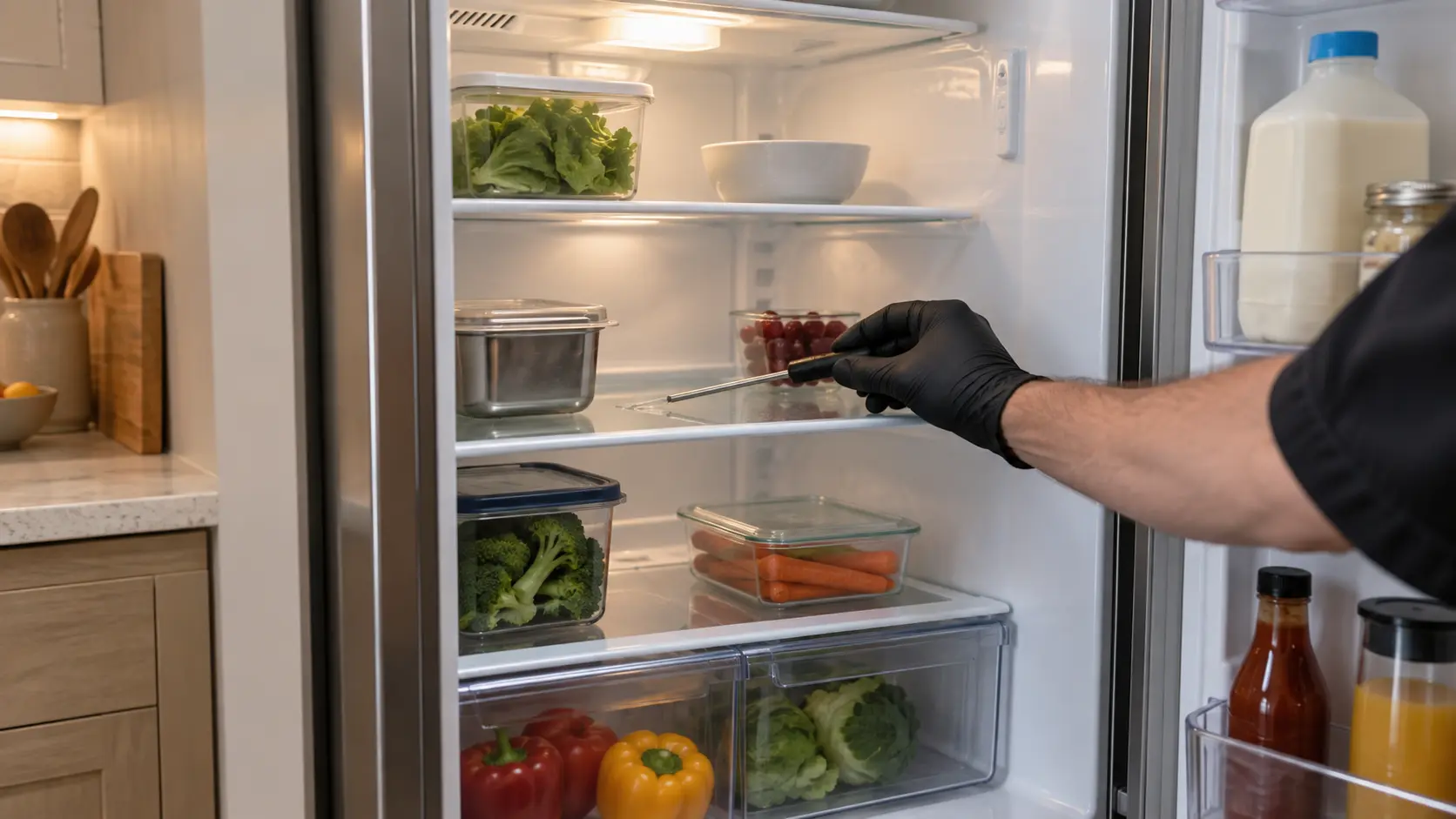

Refrigerator
Not Cooling
The compartment is warm but the appliance still has power and still makes noise.
Mon–Sat, 8am–8pm
- Food safety applies
- 5 questions that narrow it
- 7 causes, cheapest first
Book a visit
Three short steps, about a minute.
or call (844) 681-4650
Loading appointment form…
The appointment form couldn’t load. Please try again.
Food safety first
The FDA says to discard perishable food that has been above 40°F for 2 hours or more. Move anything perishable to a cooler before worrying about the appliance, keep the doors shut, and do not refreeze food that has fully thawed.
What it
usually means.
A refrigerator that is not cooling has almost always stopped moving cold air rather than stopped making it. That distinction is the whole diagnosis. Cold is produced at one evaporator and distributed by a fan and a duct, so a failure anywhere along that path leaves a compressor running perfectly while the food gets warm. Only a minority of these calls turn out to be the sealed system.
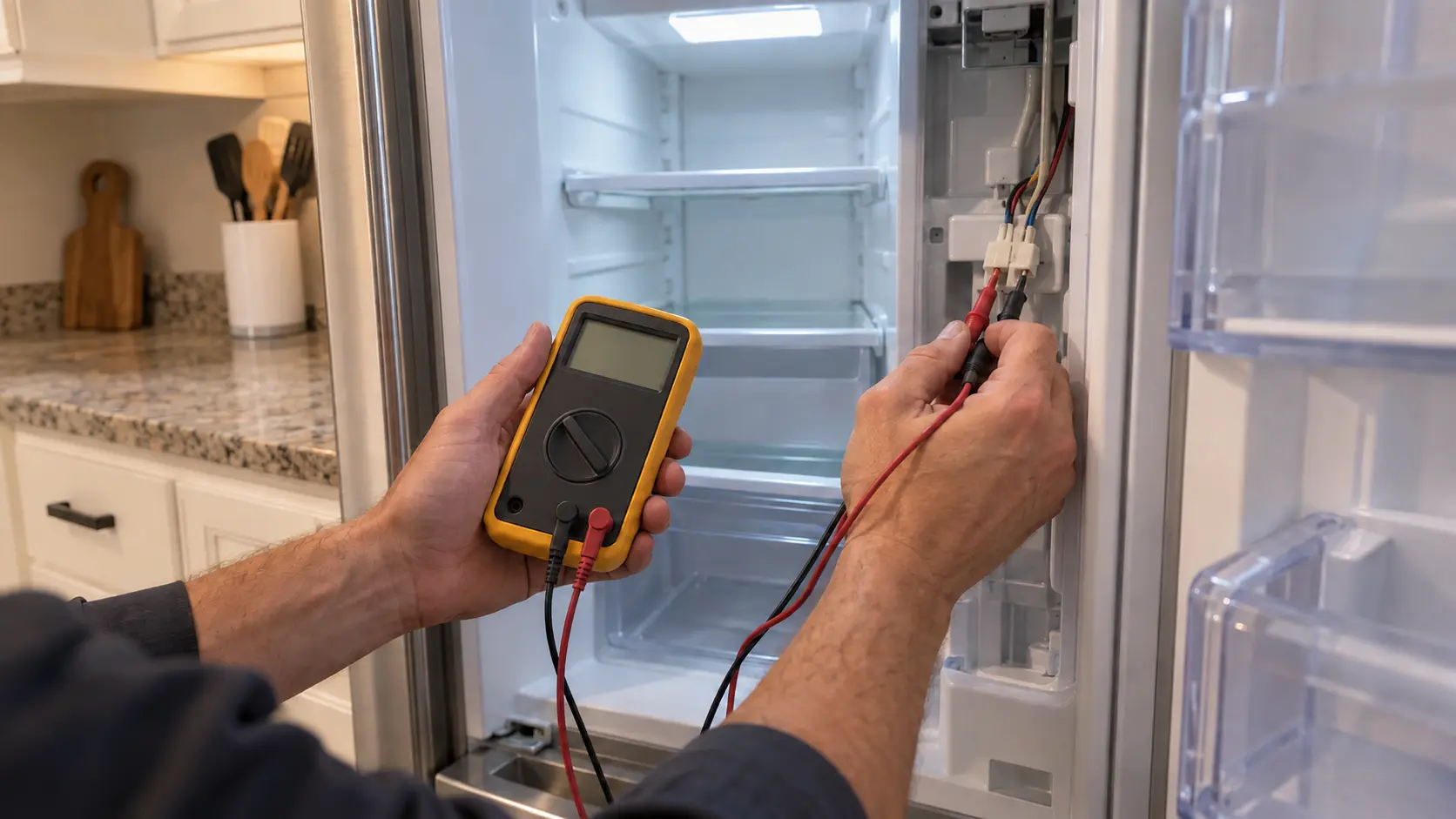 The 7 causes, cheapest first
Answer these first
Is the freezer still cold? A cold freezer with a warm fresh-food compartment is an airflow problem, not a cooling problem.
Can you hear the compressor running? A silent cabinet and a running cabinet point in opposite directions.
Is there frost on the back wall inside the freezer, or is it dry and clear?
Did this happen over a day or two, or overnight? A slow drift and a sudden loss are different problems.
Are the condenser coils or the front grille clogged, and has anything changed about where the unit stands?
Check these
before you book.
Refrigerator not cooling: 5 checks, and none of them costs anything.
Check the temperature settings; a setting changed by accident is common and costs nothing to rule out.
Look at whether the freezer is still cold, and say so when you call. It narrows the visit considerably.
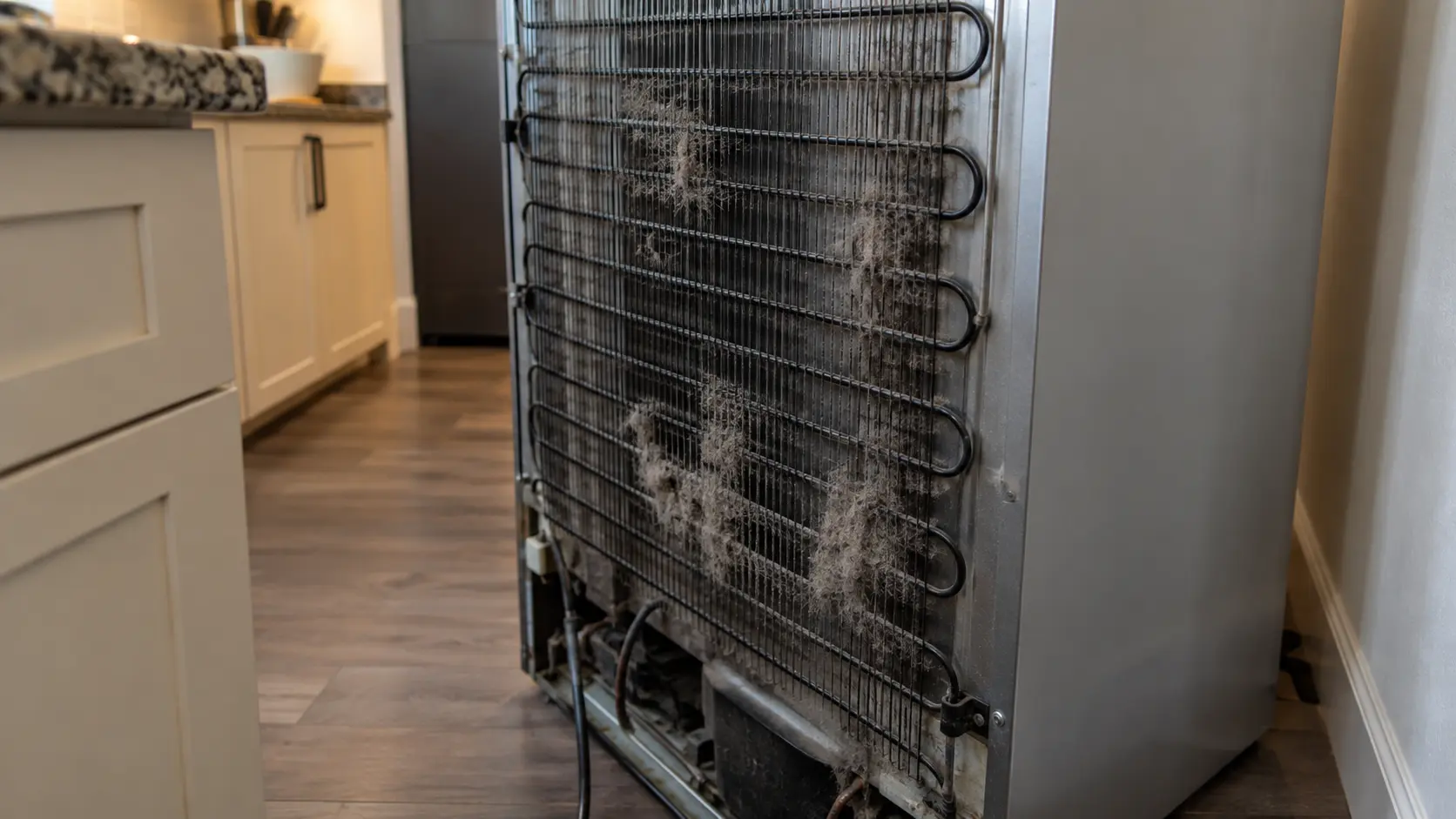
Clear the front grille or the rear coils of dust and make sure nothing is pressed against the back of the unit.
Also worth checking
- Check the door closes fully and that nothing inside is holding it open by a fraction.
- Note whether the interior light is on and whether the cabinet is making any noise at all.
The causes,
cheapest first.
7 things refrigerator not cooling turns out to be, from blocked condenser or grille to compressor or sealed system.
The cost guide-
01 lowest
Blocked condenser or grille
The appliance rejects heat through a coil. When that coil is packed with dust or its air path is blocked, the compressor runs continuously and still loses ground. On a built-in this is the front grille; on a freestanding unit it is the coil underneath or behind.
-
02 low
Evaporator fan not running
Cold is made in one place and blown to the other. A failed fan leaves the freezer cold and the fresh-food side warm, and it is usually audible as a cabinet that has gone quieter than it used to be.
-
03 low to moderate
Defrost system failure
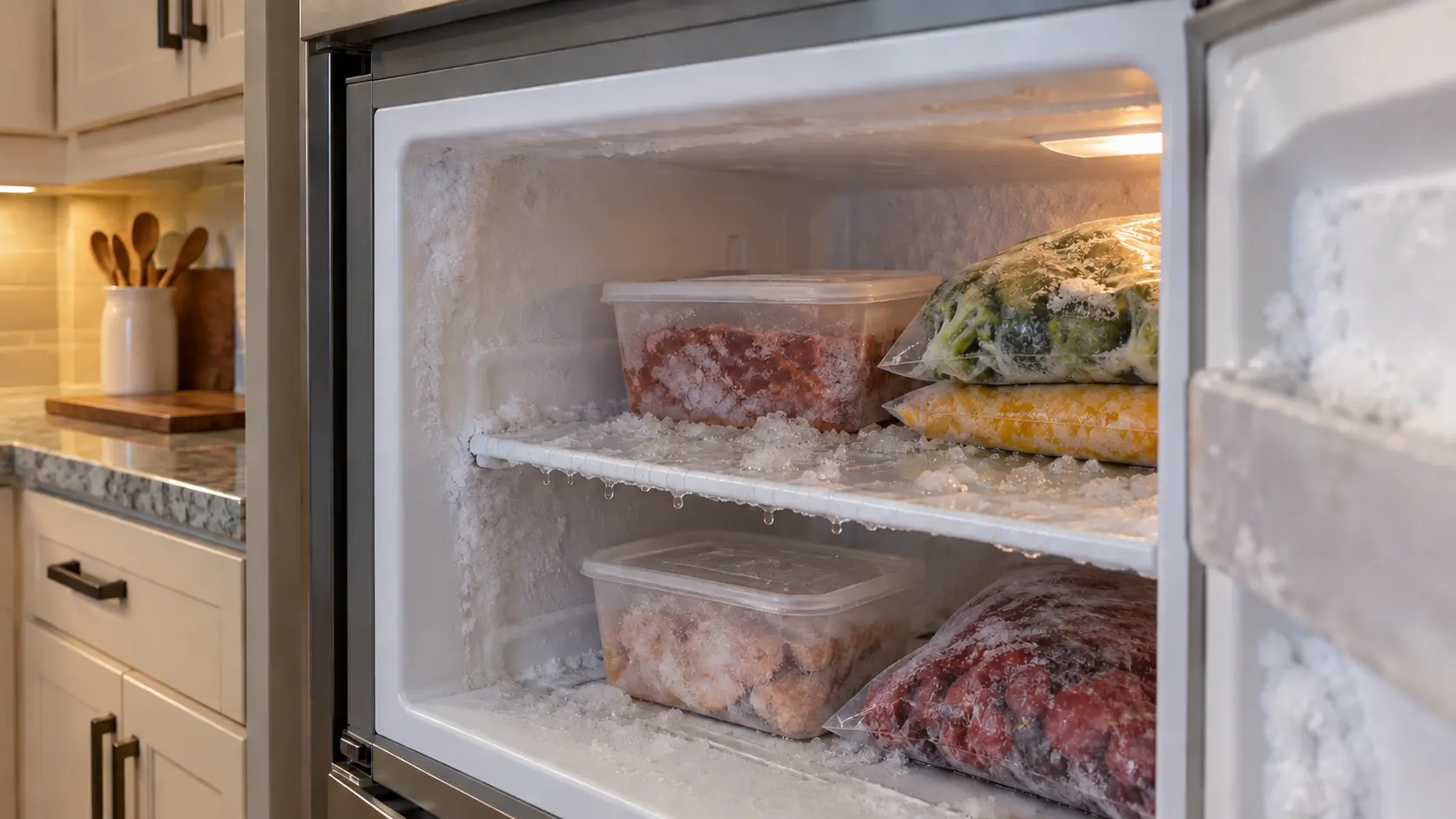
Frost that is never cleared builds over the evaporator until air can no longer pass through it. The unit cools less each day, which is why this one arrives as a gradual drift rather than a sudden failure.
-
04 low to moderate
Damper or air duct stuck
On side-by-side and some built-in layouts a damper meters cold air between the compartments. Stuck closed, it produces a perfectly cold freezer beside a warm refrigerator.
-
05 low
Door not sealing
A door held open by a fraction loads the system with warm humid air continuously. It frosts the evaporator, which then blocks the airflow, which is why this often presents as a cooling problem rather than as a door problem.
-
06 moderate
Control board or thermistor
The appliance cools to what it believes the temperature is. A sensor reading low tells the control there is nothing to do, and everything else in the system is then behaving correctly.
-
07 highest
Compressor or sealed system
A refrigerant leak or a compressor that will not start is the expensive end of this list, and it is the last thing to conclude rather than the first. On a built-in it is still normally worth repairing; on an older freestanding unit it is where the repair-or-replace question becomes real.
-
What it costs
Every repair on the site's cost scale, side by side
Open the cost guide
What else
it could be.
Most often confused with fresh food section warm, freezer cold, then freezer not freezing.
All problems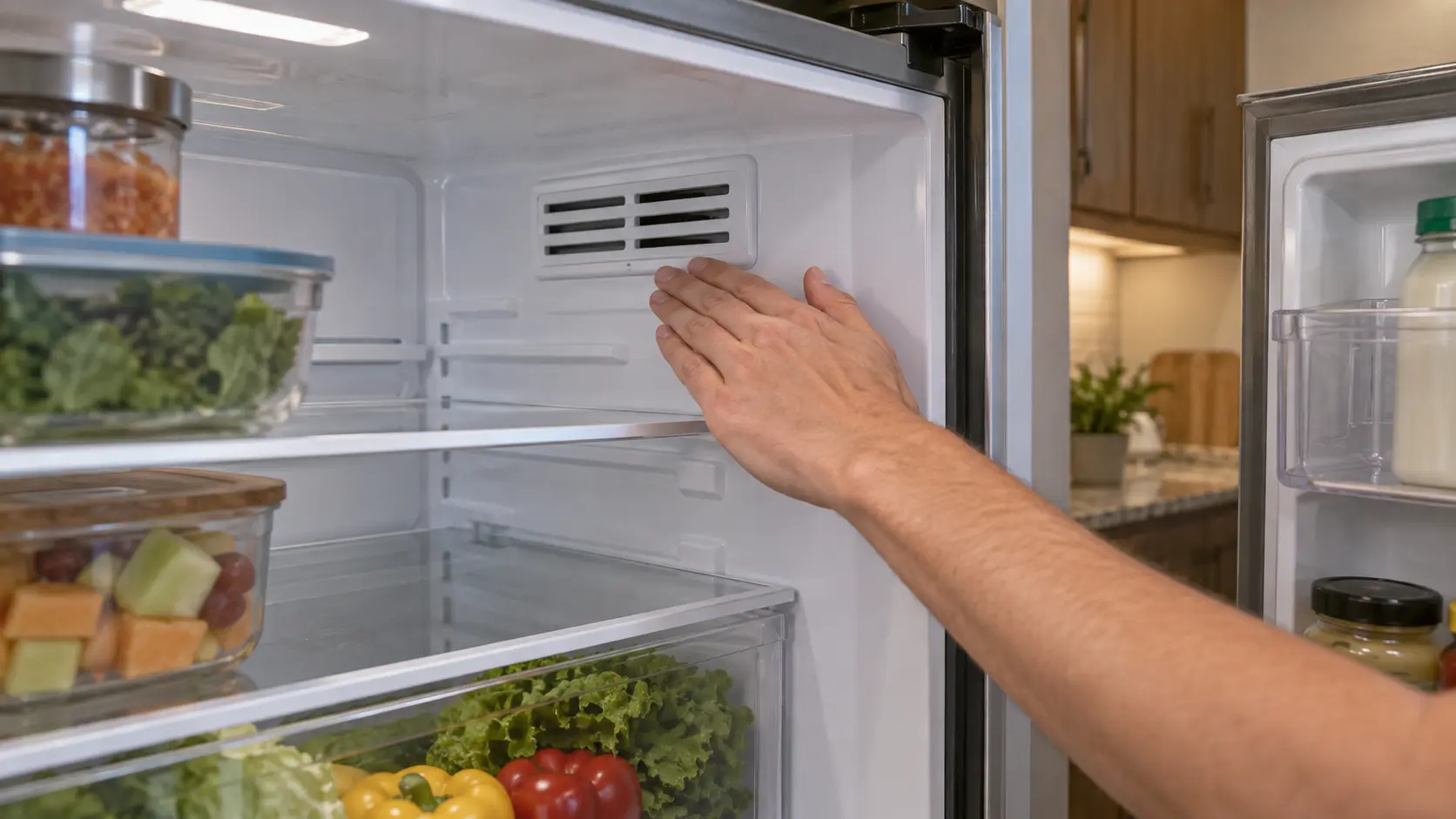
The makes
it happens on.
31 makes on this site; refrigerator not cooling can show up on any of them. Each mark opens that make's own page.
All 31 brandsRefrigerator Not Cooling,
where we come out.
9 metros, each with its own page.
All service areasTampa BayFL · 31 areas
Miami / South FloridaFL · 47 areas
New York MetroNY · 75 areas
HoustonTX · 36 areas
ChicagoIL · 50 areas
Los AngelesCA · 95 areas
San DiegoCA · 31 areas

Questions about
refrigerator not cooling.
It stopped cooling right after a power outage. Is that connected?
How long can I wait before booking a visit?
Will turning the thermostat all the way down help?
Can I fix it myself?
Back to your everyday
Still seeing refrigerator not cooling?
Book with what you checked above — 5 answers save the technician the first part of the visit.