What panel-ready actually means
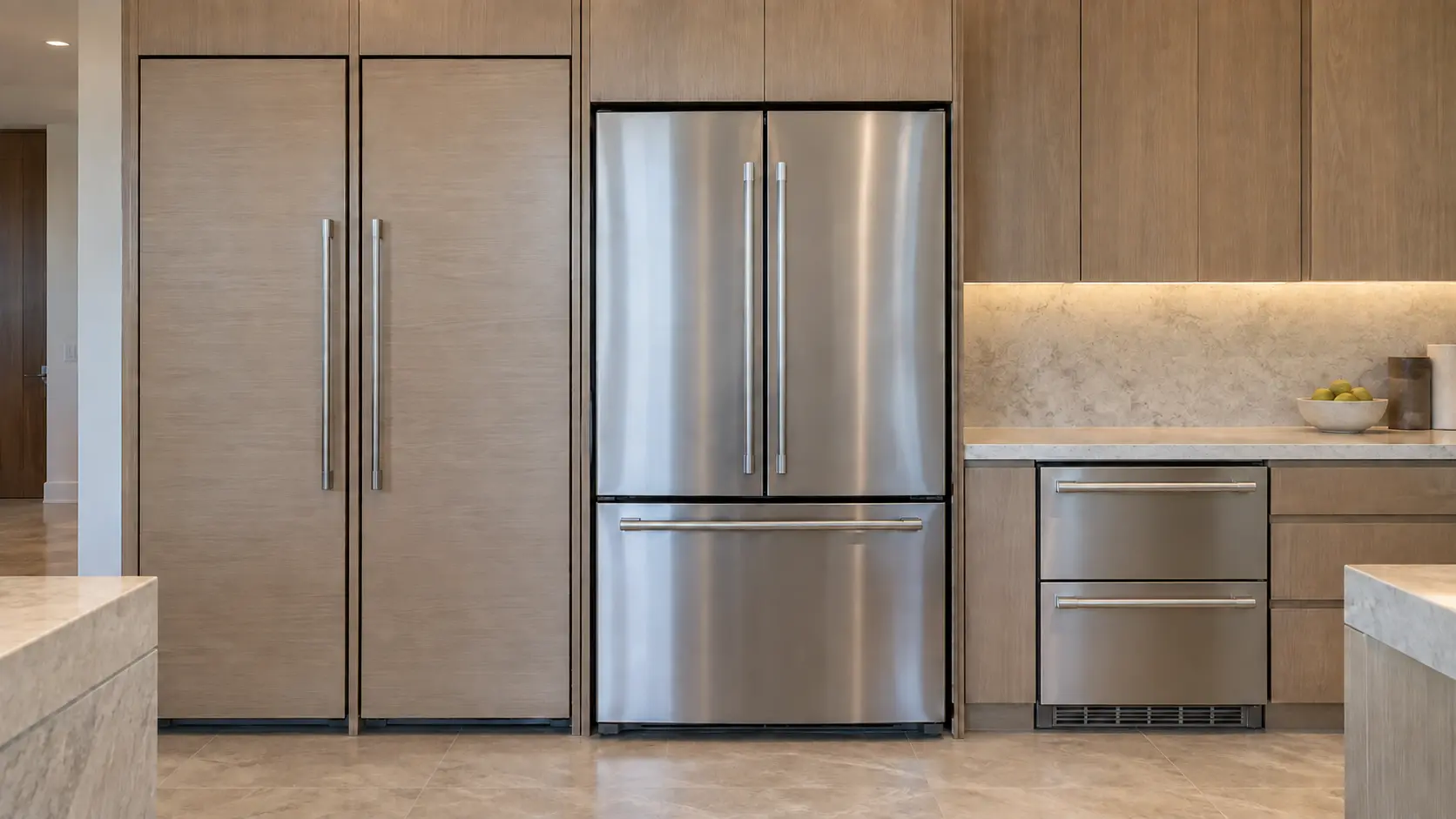
The term covers any refrigerator sold without a finished door front, meant to receive a panel that matches the cabinets. It is common on these:
- built-ins;
- columns;
- undercounter units;
- refrigerator drawers;
- a few freestanding lines, which offer it too.
Integrated and overlay
Some manufacturers use integrated for a panel-ready unit with concealed hinges and no visible grille, and overlay for one where the panel covers the door but the grille and some trim still show.
How the panel hangs on the door
Whatever the label, the mechanics are the same. The door is a steel or plastic frame with a gasket on its inner face, and the panel is screwed or hooked onto the outer face with brackets. The appliance carries the load; the panel contributes only weight and appearance.
Source: GE Monogram — 36, 42 and 48-inch built-in side-by-side owner's manual — Built-in designed to take custom panels matching the cabinets
Weight on a hinge
A full-height door with a solid-wood panel, a large handle and loaded door bins is a long lever on a small pivot. Over years the hinge wears, the closer weakens, and the door begins to drop at the handle side. The first sign is rarely a visible sag; it is usually one of these:
- A door that no longer pulls itself shut from a few inches open.
- A gasket that seals firmly at the top and loosely at the bottom.
The panel weight limit in the manual
This is why the panel's weight limit in the installation manual matters. Solid stone, thick glass or heavy hardware may look right on the design drawing, but when a panel goes over the manufacturer's figure, the result is a door that needs adjustment far more often than it should.
Source: True Residential — undercounter installation manual (door panel weight limits) — Panel limits of 20 and 10 lb; keep ventilation openings clear

The reveal tells the story
A panel-ready door is surrounded by neighbors: cabinet doors, drawer fronts, and on a column pair the matching tower. The gap between them, the reveal, is usually set by eye to a narrow, consistent width. Any change in the hinge shows up there first, as a gap that tapers from top to bottom or a panel edge that no longer lines up with the cabinet beside it.
Owners sometimes treat that as a cosmetic issue. It is worth reading as a mechanical one: a panel that has moved means the door behind it has moved, and a door that has moved is sealing on a different line than it was designed to.
A monthly reveal check
A quick monthly habit helps, and an adjustment now is cheaper than a gasket later.
- Close the door.
- Run a finger along the reveal from top to bottom.
- Compare it with installation day: when the gap feels tighter at one end than it did then, have the door adjusted.
The grille has to stay open
The condenser air on panel-ready units passes through a grille at the top or along the toe kick, and it is surprisingly common for a finish carpenter to reduce it. Each of these can choke the airflow without anyone noticing on installation day:
- a toe kick run continuously across the front;
- a crown molding that drops over the top grille;
- a panel cut a little long.
The symptom arrives months later
The unit runs longer, the compartment drifts warm in summer, and cleaning the coil helps only briefly. If the grille is not exactly as open as the manual shows, the fix belongs to the woodwork rather than the refrigerator.
Source: True Residential — undercounter installation manual (door panel weight limits) — Panel limits of 20 and 10 lb; keep ventilation openings clear
How the panel behaves on each type
On a full-height built-in or column, the panel is tall and the hinge carries it at one edge, so sag appears at the bottom corner on the handle side. On an undercounter unit or a refrigerator drawer, the panel is short but the hardware is small, and a drawer front loaded with bottles pulls down on its slides rather than on a hinge.
French door models sold as panel-ready carry two narrow panels over the fresh-food doors and a third on the freezer drawer. There the center seal is the sensitive point: if one panel pulls its door a little lower than the other, the flap between them stops meeting cleanly, and the result looks like a gasket problem rather than a panel one.
| Type | The panel | The weak point |
|---|---|---|
| Full-height built-in or column | Tall, carried by the hinge at one edge | Sag at the bottom corner on the handle side |
| Undercounter unit | Short | The hardware, which is small |
| Refrigerator drawer | Short; the drawer front is often loaded with bottles | The slides, which the loaded front pulls down on |
| Panel-ready French door | Two narrow panels over the fresh-food doors and a third on the freezer drawer | The center seal: one door pulled lower stops the flap meeting cleanly |
What to keep from the installation
None of this is required for a repair, but each item removes a delay when a door has to be rehung or a panel needs to be remade.
- The panel mounting instructions and the door template for the exact model, so a replacement panel can be made to fit.
- Any spare brackets, screws and shims left over, since panel hardware varies between product lines and is not always stocked.
- The cabinetmaker's name and the finish or paint reference, in case a panel is damaged during a move or a flood.
- Photos of the reveals on installation day, which make it easy to show what the alignment used to be.