What a replacement really costs
The comparison people make is the repair quote against the price tag of a new appliance in the showroom. That leaves out most of what a replacement involves.
Replacing a freestanding unit
Even the simple case, a freestanding unit, needs more than the appliance itself:
- delivery;
- removal of the old one;
- a new water connection for the ice maker;
- a few days of eating out of a cooler.
Replacing a built-in model
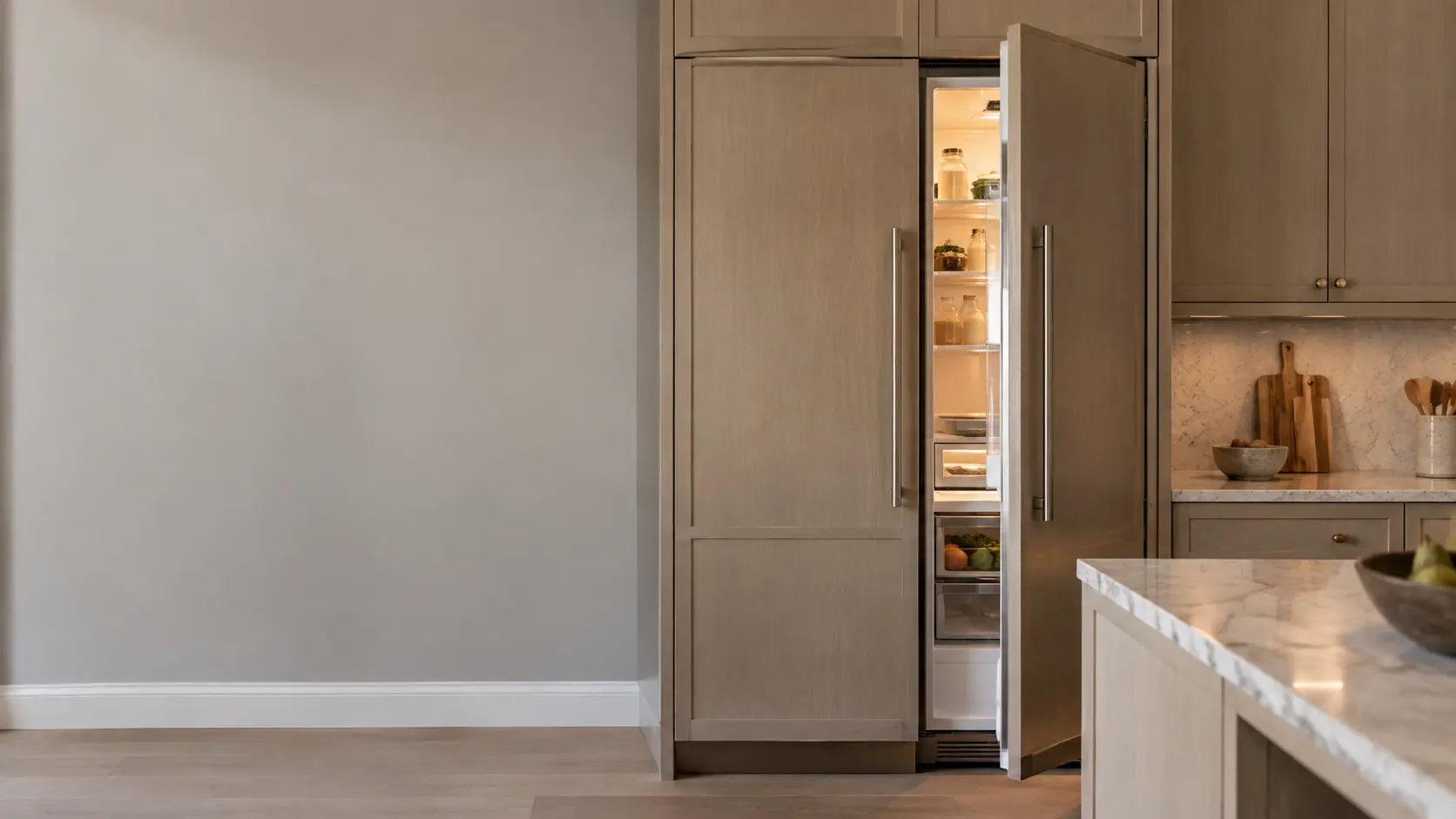
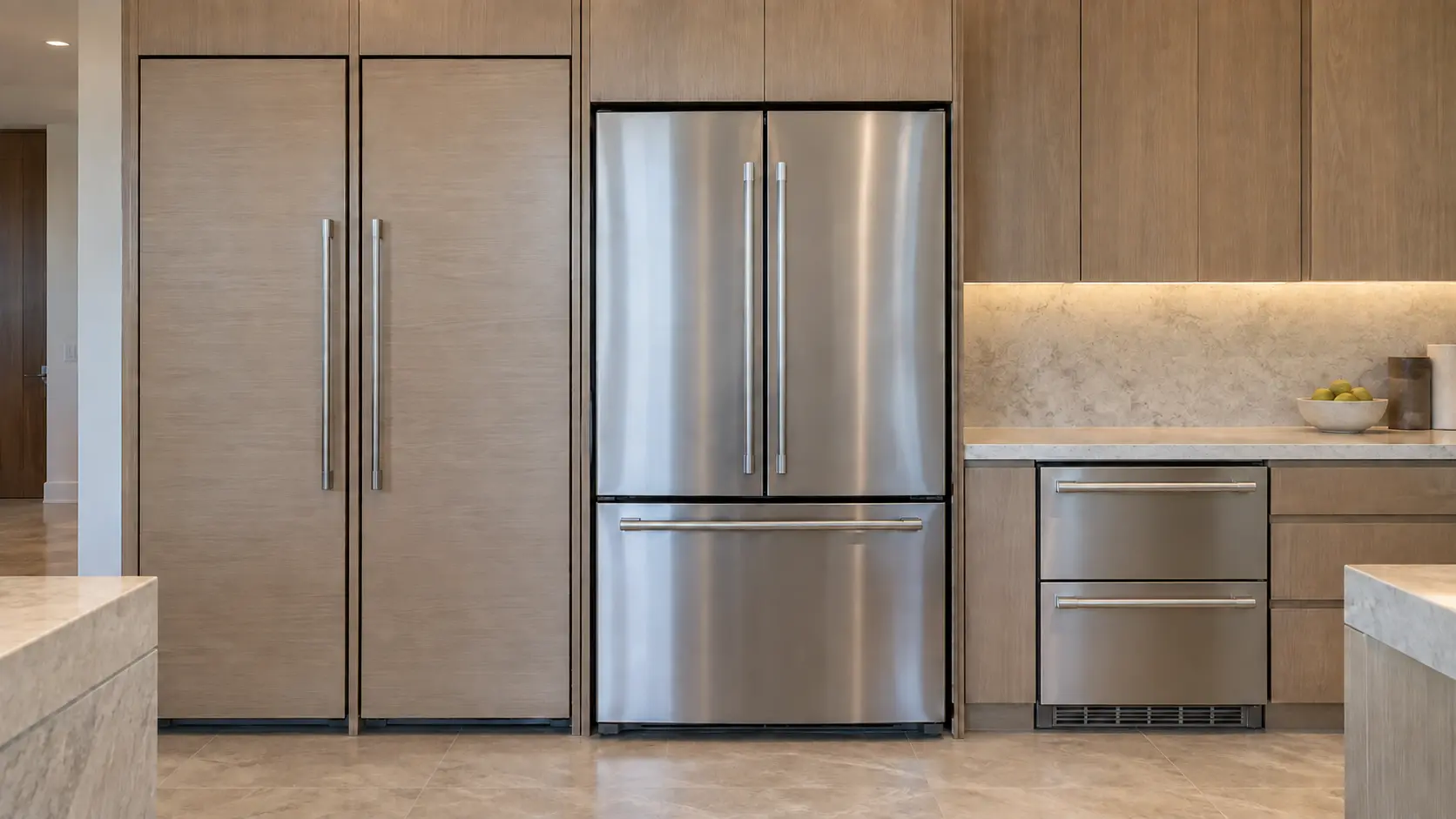
A built-in model adds the opening itself, and three things tie that opening to the appliance already in it:
- Cabinet openings are cut to one manufacturer's width, height and depth.
- Trim kits differ between product lines.
- A custom panel made for one hinge pattern will not necessarily hang on another.
When the new unit is half an inch off
When a new unit is even half an inch off, the choice becomes a cabinetmaker or a gap that looks like a mistake for the next fifteen years.
Most repairs never reach the question
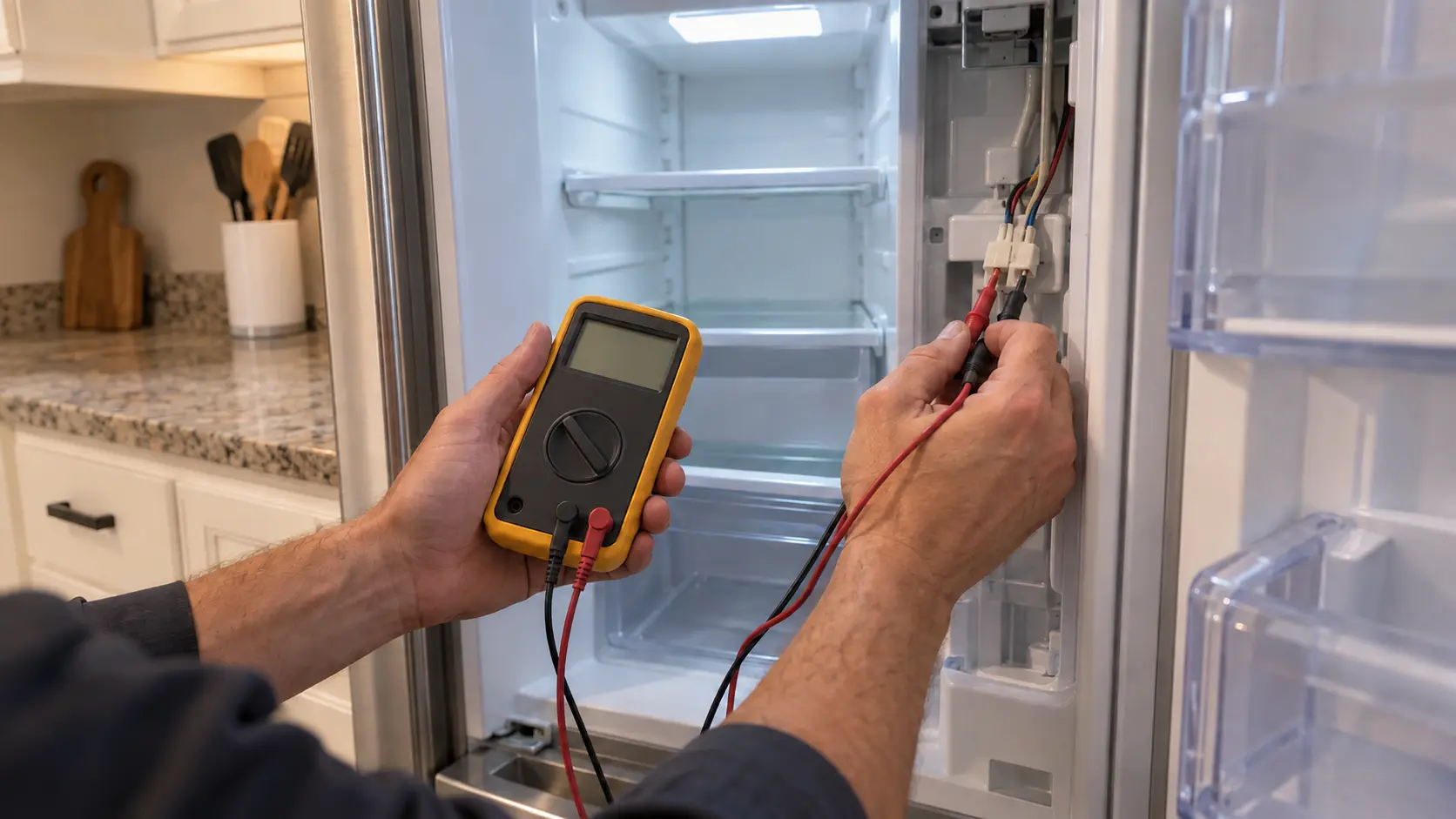
It is worth knowing where the common failures sit before assuming the worst. From the cheapest band to the most expensive:
- The cheapest kind of repair there is: a torn gasket or a door that has dropped out of line.
- The low band: defrost heaters, sensors, evaporator and condenser fans, drain clearing and water valves.
- Moderate: ice maker assemblies and control boards.
- The highest band: only the compressor and the rest of the sealed system.
Why a diagnosis comes before replacement talk
The highest-band repairs are a minority of calls on this site. A refrigerator that is warm, frosting or leaking is far more likely to need something from the first two bands, which is why a diagnosis comes before any talk of replacing the appliance.
Age matters differently by type
| Type | Usual answer | Why |
|---|---|---|
| Built-in and column | Repair in nearly every case | Designed to be repaired in place; a replacement must match the opening, trim and panels |
| Undercounter | Usually repair | The opening width, the venting and the door panel narrow the replacements that fit to a handful |
| Freestanding French door and side-by-side, fans, valves, gaskets or defrost parts | Repair at almost any age | These sit in the low or moderate bands |
| Freestanding French door and side-by-side, sealed-system failure past twelve to fifteen years | Usually replace | The money rebuilds a cooling circuit inside a cabinet that is just as old |
Freestanding French door and side-by-side units
On a freestanding French door or side-by-side unit, age is a fair guide. Past roughly twelve to fifteen years, a sealed-system failure is usually the point to stop, because the money buys a rebuilt cooling circuit inside a cabinet whose liner, hinges and electronics are just as old. ENERGY STAR also puts an old refrigerator at about a fifth more energy than a certified new one, which adds a little weight on the replace side every month.
Built-ins and columns
On a built-in or a column, age counts for much less. These are designed to be repaired in place, and an older unit in sound condition can take a new compressor and carry on. The cabinet around it has not aged at all in the sense that matters: it still fits exactly one appliance.
Source: ENERGY STAR — Refrigerators (older units and energy use, recycling) — An old refrigerator uses about 20% more energy than a certified one
The two types people misjudge
Undercounter units look easy to replace
Undercounter units look like small, cheap appliances, so owners tend to assume replacing one is trivial. The catch is the hole in the cabinetry. A 15-inch or 24-inch opening built for front venting accepts only units designed to breathe the same way, and the door panel was cut for one hinge. The shortlist of replacements that fit is often short enough that a moderate repair wins easily.
Side-by-side problems feel bigger than they are
Side-by-side models are misjudged in the other direction. Their most common calls feel serious because the appliance stops doing its job overnight:
- a jammed ice chute;
- a sticking damper;
- frost from a defrost failure.
Money spent on the wrong part
All of those side-by-side calls sit in the low or moderate bands, and replacing a working sealed system to get rid of a dispenser problem is money spent on the wrong part.
Source: True Residential — undercounter installation manual (15 and 24-inch openings) — Undercounter units built for 15-inch and 24-inch openings
Signs replacement is the honest answer
Some conditions make repair poor value whatever the type. A good technician will say so plainly rather than sell the job, and it helps to recognize them yourself.
- Rust coming through the cabinet shell or the floor of the freezer, which usually means the insulation behind it is wet.
- A cracked inner liner that lets moisture into the foam, so the walls sweat and frost from the inside.
- A second sealed-system failure within a few years of the first on the same freestanding unit.
- A control board or ice maker that is no longer made, with no compatible substitute listed for the model.
- Several unrelated failures arriving together on an older unit, each one small, adding up to the price of a new one.
How to make the call without guessing
The fastest way to repair or replace a refrigerator sensibly is to settle three facts in order:
- How old it is.
- What actually failed.
- What the replacement would have to fit.
Settling the age and the failure
Begin with the model and serial numbers, because the serial usually encodes the build date and that settles the age argument quickly. Then get the problem established by someone who has looked at the appliance, and ask which band the repair falls in before approving anything.
Pricing the replacement honestly
Finally, price the replacement honestly: the unit, the installation, the trim, the panel and any cabinetry, measured against the same opening. On a freestanding unit that sum is short. On a built-in or a column pair it rarely comes out in favor of replacing.
Source: Sears PartsDirect (Kenmore parts) — How to find the age of your Kenmore refrigerator — The serial number on the label encodes the build date