Depth is not an installation method
The built-in vs counter-depth refrigerator question gets muddled because both are sold on the same promise, a front that sits in line with the kitchen. They reach it in different ways.
| Built-in | Counter-depth freestanding | Standard-depth freestanding | |
|---|---|---|---|
| How it sits | Part of the cabinet run, screwed or bracketed into place; box roughly as deep as a base cabinet | A shallower freestanding box on wheels | A full-depth freestanding box on wheels |
| Where it breathes | Intake and exhaust both through the front grille; zero air at the back | Same layout as standard depth in less space; sensitive to a wall or a cabinet above | Condenser under the cabinet; fan pulls air in at the front and out along the back and sides; tolerates crowding |
| Capacity | Widths up to 48 inches, often taller cases | Gives up a noticeable share of interior volume | The full volume for its width |
| How it is serviced | In place, through the front, trim and grille off | Pulled forward on rollers, serviced from the back | Pulled forward on rollers, serviced from the back |
| Replacing it | A cabinetry decision | A hose and a plug | A hose and a plug |
Flush by being part of the cabinetry
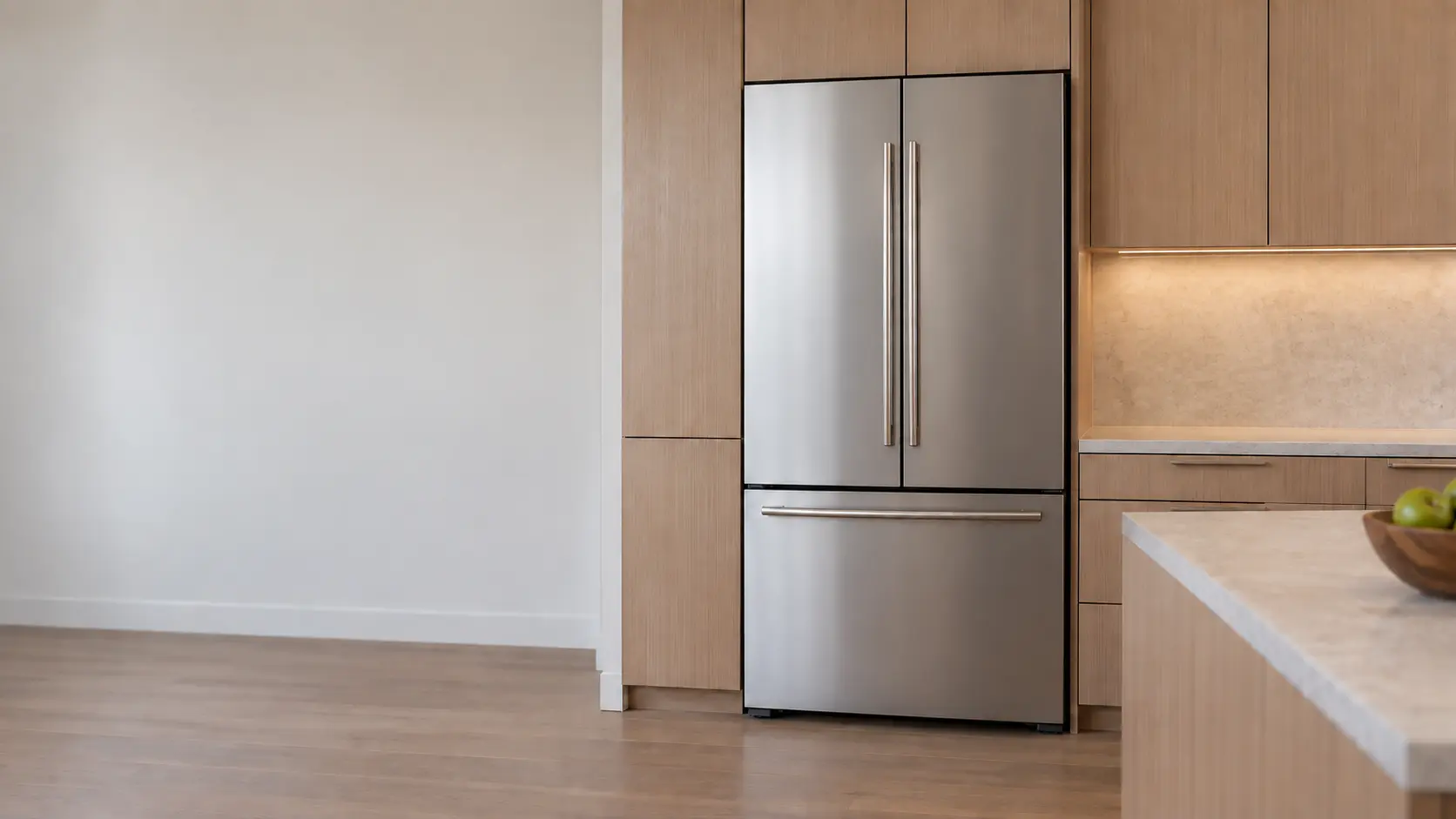
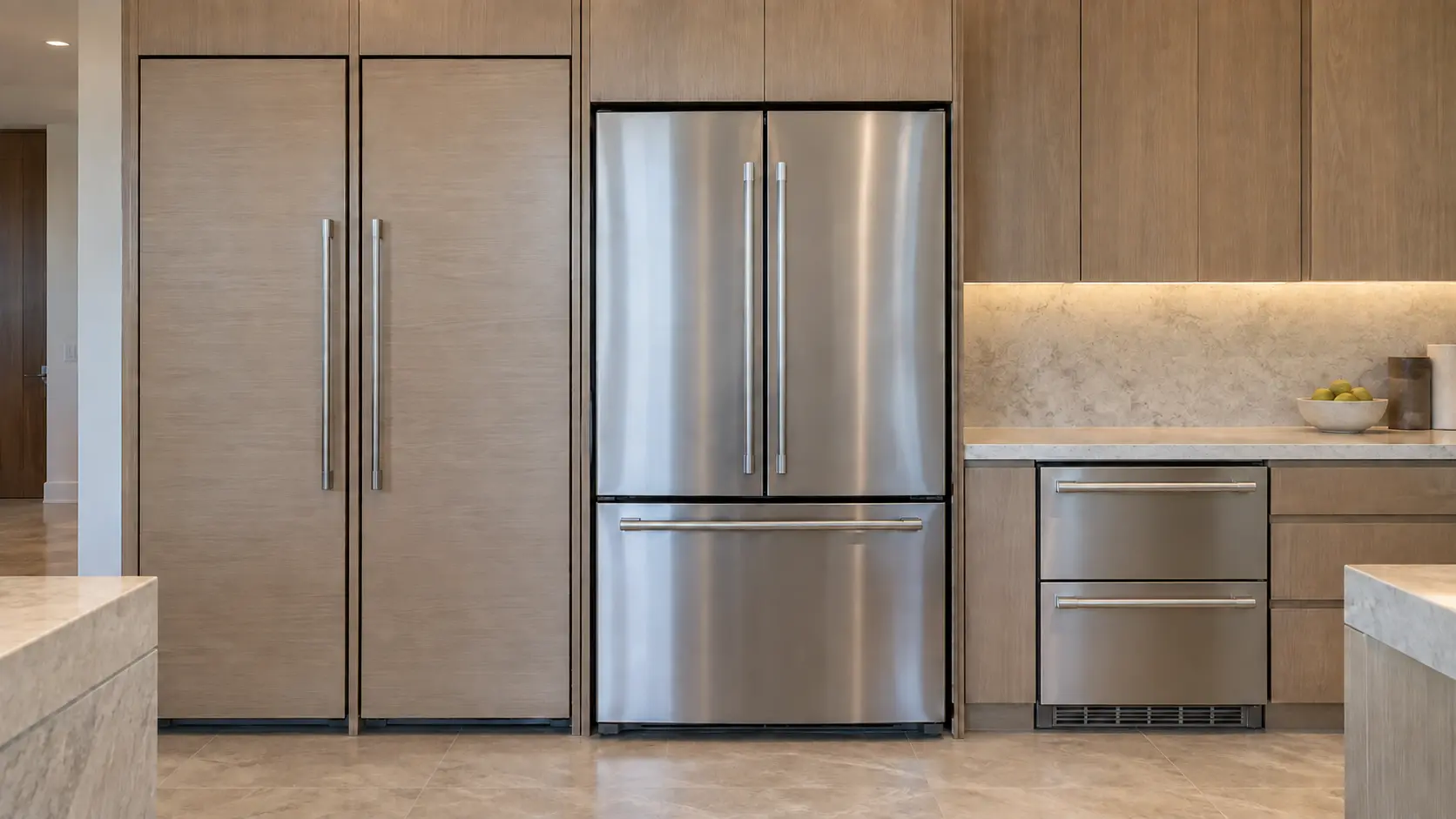
A built-in achieves the flush look by being part of the cabinet run: its box is roughly as deep as a base cabinet, its doors are the only thing in front of the counter line, and it is screwed or bracketed into place. A counter-depth unit achieves a similar look by being a shallower freestanding box on wheels.
The difference on service day
The difference shows up the day something needs work. A counter-depth French door or side-by-side is pulled forward on its rollers, serviced from the back and pushed home. A built-in never leaves its opening for routine work, which is why it is designed with every serviceable part reachable from the front.
Source: True Residential — 42/48 built-in installation manual (anti-tip bracket, leveling) — Built-in units are anchored with anti-tip brackets and leveled in their opening
Reading your own kitchen
If the refrigerator is already installed and nobody kept the paperwork, a few minutes with a flashlight settles it. None of these checks needs a tool or moves anything.
- Side gaps: open a door and look at the gap between the cabinet side and the neighboring cabinetry. A built-in is fitted tight with trim filling the space; a counter-depth unit sits with a small air gap on each side.
- The floor: a freestanding unit of either depth has a kick plate that clips off and, behind it, a coil or a fan compartment. A built-in usually has a toe grille that is part of its own ventilation or no bottom opening at all.
- Door depth: measure from the wall to the face of the doors. Counter-depth units usually come out a couple of inches past the counter edge once the doors are counted; a built-in door face sits close to the cabinet faces.
- The outlet: check for an electrical outlet you can see by looking over the top. Freestanding installations usually leave one reachable; built-ins hide it in the back of the opening.

How each one breathes
Every refrigerator rejects the heat it pulls out of the food, and the three kinds do it in different places.
Standard-depth freestanding
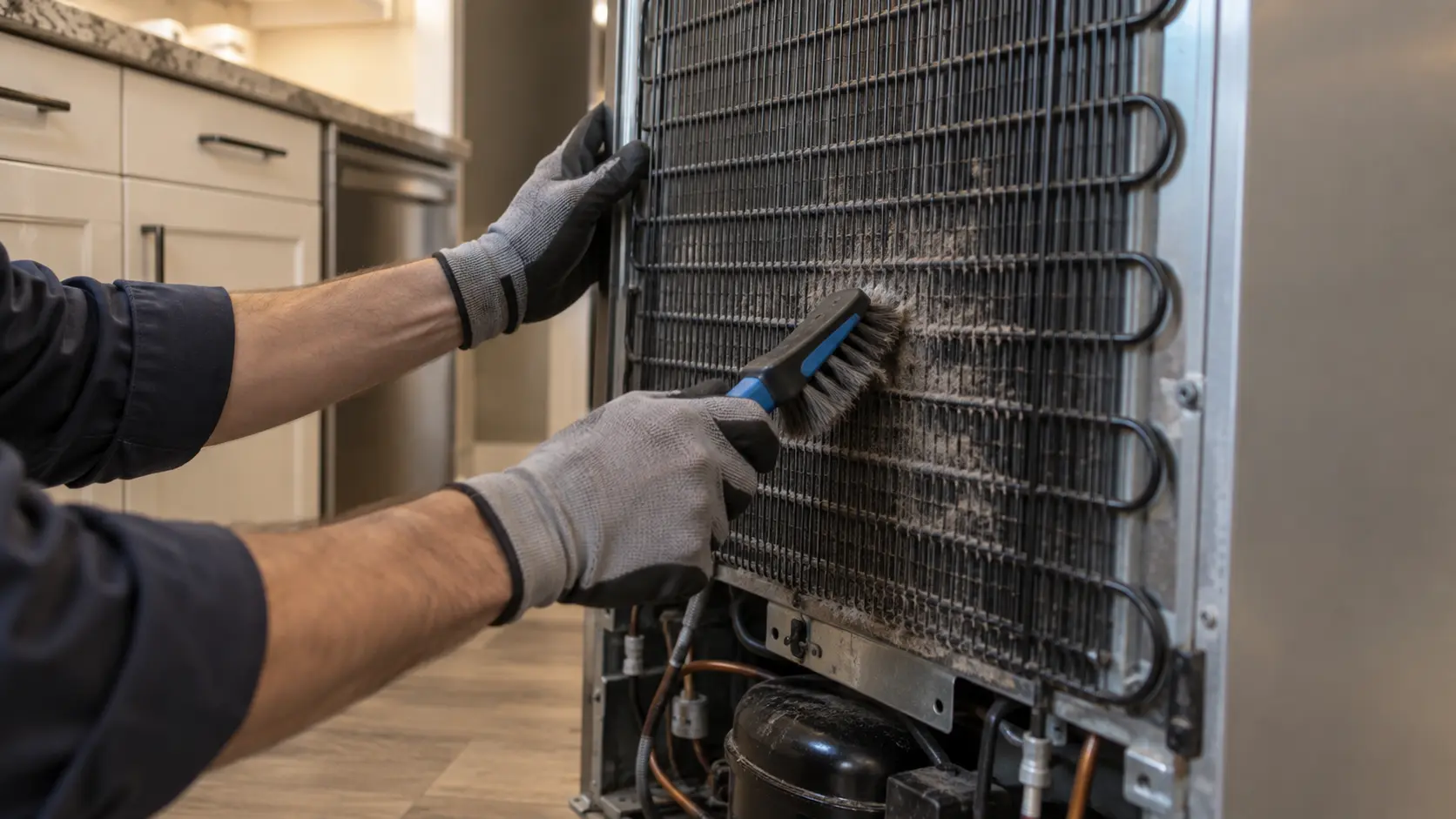
A standard-depth freestanding unit usually has its condenser under the cabinet, fed by a small fan that pulls room air in at the front and blows it out along the back and sides. That arrangement tolerates a fair amount of crowding.
Counter-depth
A counter-depth model uses the same layout in less space, so it is more sensitive to being pushed hard against the wall or boxed in by a cabinet above.
Built-in
A built-in is engineered for zero air at the back: intake and exhaust both happen through its front grille, which is why a grille obstructed by trim, a panel or dust affects it faster than any freestanding design.
Source: GE Monogram — 36, 42 and 48-inch built-in side-by-side owner's manual — Built-ins in 36, 42 and 48-inch widths; condenser behind the top grille; GE Appliances — side-by-side refrigerator owner's manual 49-60198 — Freestanding unit needs top and back air; rollers let it move out
Capacity and daily use
The shallower box costs room. A counter-depth unit of the same width typically gives up a noticeable share of the interior volume of its full-depth sibling, most of it at the back of the shelves where food used to get lost anyway. Households that shop once a week for four or five people feel that loss; couples often do not.
Built-ins win back some of the volume with height and width. They come in widths up to 48 inches, often in taller cases than most freestanding models, which is why a 36-inch built-in and a 36-inch counter-depth unit can hold noticeably different amounts despite looking alike from across the room.
Source: GE Monogram — 36, 42 and 48-inch built-in side-by-side owner's manual — Built-ins in 36, 42 and 48-inch widths; condenser behind the top grille
What each one means for repairs
Freestanding of either depth
A freestanding unit of either depth is the easiest to diagnose: coils, drain pan, water connection and power cord are all within reach once it rolls out, provided the floor in front is protected and the water line has enough slack. Replacing it at the end of its life means disconnecting a hose and a plug.
Built-in: work in place
A built-in turns every visit into work in place. The trade is that the appliance is built to be repaired for decades rather than swapped, and replacement is a cabinetry decision rather than a delivery. A typical visit goes in this order:
- The trim and grille come off.
- The technician works through the front.
- The panel, if there is one, has to be taken down and rehung for any door job.
Source: True Residential — 42/48 built-in installation manual (anti-tip bracket, leveling) — Built-in units are anchored with anti-tip brackets and leveled in their opening; GE Appliances — side-by-side refrigerator owner's manual 49-60198 — Freestanding unit needs top and back air; rollers let it move out
Choosing during a remodel
When the kitchen is being redesigned anyway, the decision is really about how long you expect the cabinets to stay. Built-in makes sense when they will outlast two or three refrigerators and the budget allows for an appliance that will be repaired rather than replaced. Counter-depth suits a kitchen that wants the flush look with the freedom to change appliances later.
Whichever you pick, have the cabinetmaker work from the installation manual of the specific model rather than from its nominal width. Openings built to a generic 36 inches are the most common reason a new unit either will not slide in or sits with visible gaps around it.